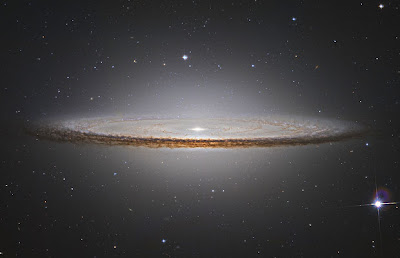
This is Galaxy M104, sometimes know as the Sombrero Galaxy. It is approximately 29 million light years from Earth (just under 290 million million million kilometres), so what we see today was the galaxy as it was 29 million years ago. No doubt a lot has happened there since then; it certainly has here. What's it like there now?
This picture of somewhere almost unthinkably remote from our own lives (but still quite close in galactic terms) reminds me of Elizabeth Jennings' beautiful short poem 'Delay':
The radiance of that star that leans on me
Was shining years ago. The light that now
Glitters up there my eye may never see,
And so the time lag teases me with how
Love that loves now may not reach me until
Its first desire is spent. The star's impulse
Must wait for eyes to claim it beautiful
And love arrived may find us somewhere else.
The moral of which may be summarised as: someone may be trying to tell you something......

 In both of these but particularly the second, we see Oxford as it were through a damp gauze, softening the image and making it more redolent of a time before Oxford became mostly a park-and-ride place still crammed with traffic.


 This painting by the Italian war illustrator Matania depicts 'A' Company of the 2nd Battlion Royal Munster Fusiliers, stopped en route to Aubers Ridge in Belgium on 8 May 1915. The central figure is Father Francis Gleeson, a Roman Catholic priest, who is pronouncing a general absolution on the soldiers before they go into battle. The next day, 19 out of 22 officers and 320 'other ranks' out of 520 died. World War I is notorious still for the high rate of attrition amongst troops, and the apparent pointlessness of the conflict - although it appeared otherwise at the time. If men weren't in charge, would this sort of thing happen?


